
Earlier this month I got to sit down with Pam Davis, CFC grad and House writer. Pam had taken some time away from the picket lines in LA to come home to Toronto and stopped by the Film Centre to talk to the CBC Prime Time TV Programme residents and I got to moderate the discussion.
Davis is modest and very low key and at the same time, clearly delighted with her job. Her most recent episode, It’s A Wonderful Lie, had just aired that week and was really terrific.
Davis had gone to the CFC after working widely in the Canadian industry but failing to break in as a drama writer. Post-CFC her luck didn’t change so she decided to give LA a shot. She had considerably more luck there.
She snagged a job as the assistant to the writers on the first season of House. She became a member of the writing staff this season. To date, she has four House episodes to her credit.
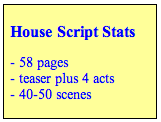
House has 11 writers in the story department and they work 50 weeks a year. That means each writer is responsible for about two scripts a season and has 25 weeks to work on each. They work long hours — ordering in dinner most nights, especially in the weeks before their own script goes into production.
(Let’s compare that to the work load in a Canadian story department. The typical story department has four writers and 13 episodes to deliver. They’ll have 2, 3 or 4 scripts each to write and the timeline is a lot shorter.)
The House story department is divided into two teams — in effect two different story departments each led by a senior writer. Davis told us that House showrunner, creator and fellow Canadian, David Shore prefers not to have story broken by the room. So on her team, each writer breaks story on his or her own and then re-works it with input from the team leader and notes from other writers.
The other team actually does break story in the room. So House has the best of both worlds.
All drafts are circulated to all writers and all writers are invited to give notes. However, nothing goes to the network for notes until the final draft. (Another great moment to do a comparison to the Canadian system. There you’ve got eleven writing minds on a script and no network notes until they’ve completed the process. Here you’ve got about four writing minds working on the script but the network weighs in at every stage: story idea, outline and every draft.)
Davis also told us about the final script stage when the writer goes to David Shore’s office. Shore loads the script into his computer. He has a second monitor pointed at the writer who watches and collaborates with Shore on the final changes. Davis says Shore’s changes always deepen and improve the work.
Sometimes Shore gives notes on a scene and leaves the room. Then the writer gets into his chair and reworks the scene while Shore plays a game of pool.
You can see by the results that the House story system works like crazy.
4 Comments
No wonder that show works. Shore gave a great quote to the Globe and Mail:
“Canadian television so often fails for the same reason American movies so often fail: They’re not controlled by writers.”
Interesting. But I would say, Jill, that in departments i have ran I would never give anything but the final draft to the networks — I’d give an outline for the first couple eps on a series but after that I’d give them three pagers and then the final draft — now I may not have run the best shows in the world but limiting input (outside of the writers you’re jamming with ) is the only way to get something half decent.
I have an idea for a show, who do I contact?
PLEASE PASS ALONG TO MS. PAMELA DAVIS:
Dear Ms. Pamela Davis,
I’ve watched House many times, and particularly like the style of the show and the way mental health issues, such as addiction are portrayed, and how there is a fairly heroic effort to preserve the ability of House to continue to be able to contribute whatever are his unique qualities, in unique and superior ways, and also because you don’t illustrate him as having a singular identity, i.e., one that is dominated by his addiction — that’s one reason we all love him, because he’s so complex, so human, and yet, still fallible. If we could clone him, that would be a really beneficial contribution to society. At any rate, I had wanted to try to convince someone to write a screenplay or episode, that would highlight a few unique or particular features of a few conditions that I believe are possibly very misunderstood, even among mental health practitioners or other medical personnel, and definitely among prosecutors, police and the like, because it might be helpful to correct the misunderstanding, and at the same time humanize those who have these conditions. See below my email to another, with a similar request (I’ve received no response). Thank you for considering this possibility, and in the event that you consider featuring something like this on House, please do me the kind favor of letting me know in advance, as I don’t presently keep a tv in my apartment. Thanks so much, and also for writing House!!!! The portrayal of House on the show is comforting to a lot of people, because he is not dehumanized because of his fallibility, not thought of as only an addict, and because we still get to see him contribute what wouldn’t exist if he were treated that way. Because life is and should be about addition, and when we distinguish a light because of a fallibility, we diminish the good in the world.
Sincerely,
Andrea Ousley
TO: Ms. Tina Kahn, please pass along to Mr. Jacob Bloom, as he has no email address listed. Thanks.
Mr. Jacob Bloom
Intended for, and please pass along to Mr. Ron Howard
Bloom Hergott Diemer Rosenthal LaViolette Feldman & Goodman, LLP
Beverly Hills, California Office
View all offices
150 South Rodeo Drive, Third Floor
Beverly Hills, California 90212
(Los Angeles Co.)
Telephone: 310-859-6800
Omnifax: 310-859-2788
Edit>
——————————————————————————–
From: ndr_ousley@hotmail.com
To: r.howard@imagine-entertainment.com
CC: ndr_ousley@hotmail.com; atoews@med.unc.edu
Subject: RE: Just a thought
Date: Fri, 5 Jun 2009 15:12:01 -0400
r.howard(at)imagine-entertainment(dot)com
June 5, 2009
Dear Mr. Ron Howard,
I’ve recently watched (again) your production “A Beautiful Mind” and wanted to ask that you might consider producing a film, based on a screenplay not written, that tries to highlight conditions that are, unfortunately, very often either misunderstood or else used in a way, or taken advantage of for non-benign purposes. I (and my sister) were really very ordinary girls, from a small town in North Carolina (called Garner, although we lived in a neighborhood outside of and apart from until annexed, near Raleigh, the capital), we were born of a mother who came from Pender Co., NC, a very, very small place with really nothing more to its name than a church, called Shiloh Baptist Church, and a Piggly Wiggly, just farm land, where people grew tobacco, soybeans, corn, and the like, and just lived pretty straight lives (believing such as that idle minds lead to no good, and that children if left to their own devices will get into trouble), going to church, carefully regulating the activities of their children, and trying to create for their sons and daughters a different and better life. That said, it was a wonderful experience at least for me, visting my grandparents on the farm, where they lived in a white (gunshot, correct term?) farmhouse over 125 years old, built of solid timbers, in the midst of camellias, important to our family because my uncle bred new varieties of them, and my aunt painted them, very beautifully, and roses, and fig trees, with a few picturesque farm buildings, henhouse, pack house, smoke house, in the midst of a buffer of pines and just close enough to the fields so that you could hear the wind rustling through the field, against the corn, with the sun peeking in through tall windows in a room with very high ceilings, and a fireplace in each room, just so very peaceful and quiet, really there was nothing more blissful, it just rested the soul. My grandfather was a very tall, stern, no nonsense sort of man, but very, very decent, and authentic (think Clint Eastwood in The Bridges of Madison Co., without the affair aspect), and my grandmother, a very, very fun, cheerful lady, who was just always content with the activities of the farm life, and her domestic realm — what was typical for that region, scuppernong grape pies, strawberry and fig preserves, really, dark, green, very, very sweet pickles, dark, syrupy, sweet southern tea, and the like. For me it rivaled something like Provence. We were born of a father who came from Buies Creek, NC, which is the town of Campbell College, and was born the last of about 12 or 13 births. He was one-half Scottish, his mother having been Scottish, who was a very delicate looking woman, and apparently very gentle, and the paternal side having come here to the South Carolina region (or at least having settled there by then) in about year 1790, about which I do not know a lot in terms of ethnicity or country origin, although the paternal side of the family believes them to have come to America from England. My father’s father moved the family to Buies Creek, NC so that his children could attend a high school there, one affiliated with Campbell College, and so as a group they probably got a better education than many poor farm kids, since, for religious reasons, the family had decided not to grow tobacco, the cash crop (and also, they either couldn’t afford or declined to own slaves, as far back as 1790, at least in SC and that I know of, in NC). The point of this is that my sister and I came from a very ordinary, and very kind, gentle background, and we did as much as we could with it, having rather ordinary childhoods, with the exception of a terminal cancer that our mother was diagnosed with when my sister was only 10 years old — my mother died very early, while my sister and I were both undergraduates and UNC-CH, and perhaps in some way it was the beginning of what would come, she being so very willful, and so very determined in terms of every aspect of our upbringing, which she regulated very tightly and carefully, so that we wouldn’t get into any trouble, and largely, we didn’t. We got through UNC-CH, both finished our graduate degrees and started to do biomedical or psychology research at various institutions. We both had very abusive marriages, unfortunately, but survived them at least, my sister continuing her psychology research and getting a professorship position, and I deciding to attend law school in order to combine a science background with law, in order to practice patent law. Anyway, my third year of law school, all hell broke loose (see, for example, my email of 6/4/09, ndr_ousley@hotmail.com, pw: DF51663JKl) without my being able to discover the reason for it, and there has really been no recovery, and in effect, that pivotal event destroyed everything they had done and contributed for me. Apparently a false rumor was circulated, and one of the parties in question (see email of 6/4/09) had some direct encounters with me, for example, in his office, and he apparently (I’m guessing) had a elevated level of confidence in his ability to “read” people, having served as a prosecutor in the Boston, MA area, and misinterpreted me behavior, leading him to believe, more likely than not, that the rumor was true, when it was not. My suspicion is that he, at some level, and most possibly at one that was more intuitive than conscious, interpreted my apparent “delay” in processing as dishonesty or as evidence of my covering something up, when in fact, I have an anxiety disorder, probably because I was a premature baby, as many premies in fact do have generalized anxiety disorders, and thus I’m a bit hypervigilant when having direct encounters with others, in that I just automatically search their face for small non-verbal cues, such as a Duchenne smile and the like, and secondly, because I believe, even though I’ve not been diagnosed, I am somewhere on the autism spectrum, or at least have some features of autism, which can include a “delay” in processing, as well as a less sophisticated understanding of social situations, particularly those with which one doesn’t have experience, such as being scrutinized by a former prosecutor (who is supposed to be playing the role of professor, and thus who is supposed to be benignly situated towards his students, of which I was one, and who is supposed to be empathetically situated towards anyone who is a victim, including of a false rumor that could jeopardize entirely their possibility of a law career, but who wasn’t either). Nevertheless, I tried to continue my studies that year, but was drugged (without at first realizing what was happening, bec. I didn’t have experience with drugs), probably because someone recuited someone in my household to do that because they wanted to create a convenient narrative for why I wouldn’t be finishing law school (the only reason I believe that I was allowed to return is because when I filled out my leave of absence form for my law school, I wrote in an additional statement, that I would be continuing my studied the following semester). My story is actually a lot more complicated even than this, as another complicating factor, and possibly the reason for the circulated rumor, is that I was, I believe raped as a undergraduate, and I believe that the parties in question waited to see, first, if I seemed to know or to be telling anyone, and secondly, later, to determine if I remembered, and then, when the rape issue was revived during my third year of law school (by the professor referred to above), I believe that some had an interest in creating a narrative that would result in my not ever being able to practice law, meaning the onset of apparent mental illness that was really just my being drugged in my residence third year of law school, and that would culminate in a more convenient narrative, that of my complete and final downfall, which would result in my more likely than not, having to live at home where I grew up, for the rest of my life, without any appropriate and challenging options for work and meaningful activity, as my entire life had been up to then comprised of work and study, with everything revolving around that orbit, as might be expected for someone with features of autism, as I just wasn’t the suburban cookie-baking type. I did gradaute from law school, and I did pass the NY bar exam, but haven’t been able to find a permanent position in law, and as you might guess, there’s really almost no law practitioner who is practicing and advocating in the area of strengthening civil rights of those who have been diagnosed with, treated for, or who are perceived as having mental illness — there is literally no one in the US who is working for that or for stronger, meaningful protections for this group of people. This group is one of the most vulnerable groups, and unfortunately, not only society at large misunderstand them and abuse them or treat them in violent manners, but often their families take advantage to their newly acquired “power over” the person who has been diagnosed or treated for mental illness, in manipulative or abusive ways, and when the individual complains about the treatment, they are often not believed. It’s unfortunately, the kind of injury you cannot prove in black and blue, and it’s a kind of prejudice that you apparently cannot recover from. For example, since I was committed (my only commitment, ever) during my third year of law school, for 6 days only, without meeting the state statutory requirements for involuntary commitment in the relevant state, that of Virginia, I have been drugged and harassed in my residence, in almost every residence I’ve lived in since graduating from law school, my car and apartment has been vandalized, I’ve experienced multiple attempts to end my life in my residences, and in every place I’ve visited since graduating from law school, with few exceptions, without being able to discover the reason for it, as I just hadn’t comprehended how deep and pervasive, and how strong the bias against those who are perceived as having or having had, even for a brief time, a mental illness. The prejudice is particularly highlighted in my case, since I’ve never been diagnosed with anything that required continuous or prolonged treatment, and in fact, that wasn’t consistent with my claims about third year of law school, ie., that I was being drugged, having rather been diagnosed and treated for a mild depression following an abusive marriage and divorce, and then, again, years later, for mild depression because I was upset that my law career had been disrupted to abruptly and so violently (broadly defined), when it was really my last chance at a very independent life, where I had hoped to be, forever, free from abuse, psychological or physical. My case is also further complicated because I was raped during this time, but that may be a more minor factor. I guess what I wanted was for someone to consider writing this story, not necessarily true to the facts or players, with the aim of highlighting i) the disorders of autism (which is predominated by our impression of “Rainman”, when in fact, probably a lot of people, including software engineers and scientists, have features of autism, not necessarily classic autism, but features of, perhaps closer to the idiot savant type, without necessarily being as brilliant as Nash) and/or anxiety disorders (although these two conditions have some things in common, such as compromised social skills, and a less sophisticated or what I call shallow understanding of social situations), and ii) the extreme prejudice, bias, and in fact, sheer hatred that those who are perceived as having or having had a mental illness, or even a mental condition, experience, often with very few or no advocates, as their family members either may simply not be sophisticated enough to understand the complexities of their disease, and/or they use it in harmful ways, as a means of exercising power and control over that individual in inappropriate and harmful ways — it can literally rip a family apart, and destroy bonds that were forged over decades, and even between sisters, in fact, in my experience only the parent-child bond was strong enough to withstand all that happened, and iii) how vulnerable these individuals are, both to harassing and intimidating treatment done for the purpose of making them ineffective potential witnesses against their rapists, abusers, or others, including even those who commit violent crimes against them, including also attempts to end their life, e.g., for example, they are very vulnerable to being “gaslighted,” which I didn’t realize was a common strategy for abuse against those perceived as having or having had a mental illness or condition. Also, I had hoped that someone might consider writing this story with the aim of suggesting what legal mechanisms might be put into place to protect against this kind of scenario ever being repeated — it can literally make a person’s life a sheer hell, particularly for those individuals for whom autonomy, independence, agency, and voice are some of the most important aspects of life, and for which they would suffer a fair amount of physical injury. For example, many hate crimes laws, which might apply to these individuals, have a requirement of “force or threat of force” and/or require proof of that the crime was motivated by the prejudice, when in fact, for someone who is in a mental illness category, it is very easy to do an equal amount of harm, for example, by injuring their lungs and/or heart irreversibly, without them being able to prove it easily (e.g., I live in an apartment building, and if someone comes in and does something that would damage my lungs or heart, or if I am in a roommate situation and the same thing happens, while I may be able o prove that I have an injury, I might have a very difficult time proving who did it, without installing cameras in my residence, and further, it wouldn’t constitute “force or threat of force”, and I would have an even more difficult time proving a hate crime motive, because the person would just claim, no, it was another motive, and deny it). Basically, I’d like a strict liability hate crime law where you just have to prove harm done by another, to someone who belongs to the perceived as having, been treated or diagnosed for, a mental illness or condition, class, and where the law perceives the victim to be an “egg-shell” victim, meaning you take them as you find them, and the victim doesn’t have to have advertised the fact of belonging to the class, nor put the likely hate crime actor on notice as to that fact prior to the hate crime event. I realize that mental illness probably has a long history of destroying families, but it would help dramatically, if everyone who ends up in this position, at least had a strong law guaranteeing repose in one’s residence, as repose is very important to this class of individuals because they may be facing hostility and abuse in many contexts outside the home, and a strong law might help shape the dominant social norm towards this group of people. Telling this story, or a similar one, might also help educate mental health practitioners and other MD’s about the complexities involved in treating or diagnosing mental illness, so that they may better educate or prepare family members to deal with it, and help highlight the perspective of the patient, hopefully increasing their empathy towards them. I think MD’s have a tendency to view individuals with mental illness very categorically, rather than in their full light, succumbing often to the error that each person has a singular or dominant trait, that of their mental illness. Note that it would be difficult for me to write it, because I just do not understand the motives at play when people hurt vulnerable people, I don’t understand what drives people to do that, and I probably never will. I’ve given you access to my email, which starts from March 2005, when I had just taken or was just about to take the NY bar exam, with some emails reaching back to report on earlier events. Thanks for considering this idea.
Sincerely,
Andrea Ousley
PS. In the event that Ron Howard might consider such a movie, my sister, Opal Ousley, at oousley@emory.edu, could be contacted, and/or in the case of my demise.
PSS. You may pass this along to anyone else who you think appropriate and who might be interested in a similar or joint project. Thanks again!!
One Trackback/Pingback
[…] via WikipediaEarlier this year, I interviewed Pam Davis, a writer for House, at the Canadian Film Centre. I just got an email from Pam […]
Post a Comment